
#Ecommerce #InventoryAgility #LCCart #BulkOperations #DatabaseManagement #MerchantLife
LC Cart’s early, hands-on involvement in real merchant go-to-market workflows laid the groundwork for something most platforms never achieve. A system where inventory scale does not slow execution. Where bulk operations are reversible. Where mistakes are expected, not punished.
That sounds like strategy language.
I am living inside the reason it exists.
Right now.
The Story You Do Not See in Case Studies
I am mid-edit as I write this.
A filtered export. A few thousand rows. Prices, metadata, structural flags. The kind of bulk work that looks simple on paper and quietly destroys afternoons in real life.
CSV open in Excel. Product Manager in another tab.
Everything is moving fast. Too fast, maybe.
Then it happens.
Halfway through the list, that familiar punch in the gut.
“Oh no. I forgot xyz.”
Not a catastrophic mistake. Just one condition I should have applied differently. On most platforms, this is the moment where bulk tools stop pretending to be bulk.
You either live with the mistake or you start over. Slowly. Carefully. Hoping you remember what you already changed.
Anyone who has done serious inventory work knows this moment. It is where confidence evaporates and fear takes over.
Where Most Bulk Tools Quietly Die
The truth is simple. Most bulk tools are only bulk until you actually need them.
They are designed for demos, not pressure.
Change one field. Apply to all. Looks great. Until you need to undo part of it. Or isolate a subset. Or reverse a decision you made ten minutes ago with incomplete information.
Correction is where systems break.
Bulk assumes perfection. Merchants operate in reality.
The Other Story Happening at the Same Time
Here is where the second story runs underneath the first.
LC Cart was built by merchants who hit this wall themselves. CorundumStones Mining Estate did not design for theory. They designed for survival in a market where inventory is high value, unique, and constantly in motion.
That strategic involvement shows up in moments like this one.
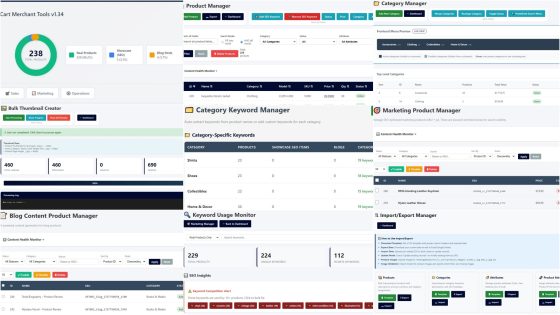
Instead of panic, I open the Product Manager. One search. One filter. Instantly, I isolate only the affected products. I remove the edits cleanly. No collateral damage. No database gymnastics.
Back to Excel. Fix applied. Re-imported.
Seconds, not hours.
The system assumes I will forget something. And it gives me a fast, clean way out when I do.
That is not a feature. That is philosophy made operational.
When Inventory Stops Being Fragile
This changes how you behave as a merchant.
You stop tiptoeing around your catalog. You stop delaying improvements because “it is too risky to touch everything.”
You iterate more. You test more. You refine pricing logic, categorization, and SEO structure because you know mistakes are reversible.
Bulk work becomes something you lean into instead of something you fear.
At the same time, every edit feeds a larger machine.
Keyword maps. Narrative templates. Marketing product management. The showcase strategy that turns a clean base catalog into search-focused landing pages without bloating core inventory.
Inventory stops being a liability and starts acting like infrastructure.
The Strategic Outcome, Seen From the Inside
This is what that earlier strategy language really means.
A scalable operational framework is not a slide. It is the ability to pivot thousands of records in minutes. To correct errors instantly. To move with the market instead of chasing it.
Messaging platforms and sales tools do not matter if the database underneath them is fragile.
LC Cart’s advantage is not speed alone. It is speed plus reversibility, backed by database integrity.
That is why it works in environments where other platforms quietly fall apart.
The Real Takeaway
Bulk editing is not about scale.
It is about recovery.
If a system cannot let you correct mistakes instantly, it is not a bulk tool. It is a risk disguised as convenience.
High-agility inventory is the real competitive edge. Whether you sell rare gemstones, industrial components, or commodity products, the principle is the same.
Move fast. Fix faster. Keep going.
Everything else is just interface polish.