
#Ecommerce #PricingStrategy #SmallBusiness
Feature 2: Bulk Price Adjustment (The Morning Everything Changed)
Costs don't announce themselves.
Shipping goes up 8%. Your supplier raises minimums. Stripe adjusts fees. The dollar weakens against the yuan.
You don't notice until you run the numbers and realize every product in your catalog is underpriced by 6-12%.
Not catastrophically. Just enough to eat your margin for the last two months.
On Shopify, you have options:
-
Click into 847 products one by one and adjust each price manually
-
Export to CSV, edit in Excel, re-import and hope nothing breaks
-
Pay for an app subscription that does bulk edits (but also injects itself into your stack)
-
Use the API if you're technical enough and trust yourself not to wreck the database
All of these take hours. Some take days. Most introduce errors.
LC Cart does it in one screen.
What the feature actually does:
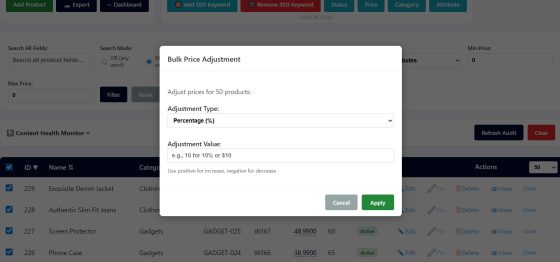
You open the Product Manager. Select your products, either all of them, or filter by category, price range, keyword, whatever.
You see a bulk action dropdown: "Adjust Prices."
You choose:
-
Increase by percentage (e.g., +7%)
-
Decrease by percentage (e.g., -10%)
-
Increase by fixed amount (e.g., +$5.00)
-
Decrease by fixed amount (e.g., -$3.50)
You click apply.
Every selected product updates instantly. The database writes the new prices. Your storefront reflects the change immediately.
No export. No re-import. No apps. No waiting.
Done.
Why this changes how you think about pricing:
Most sellers avoid price adjustments because the friction is too high.
Your costs go up, but you delay the price increase for weeks because you "don't have time to update everything."
You want to test a 5% increase on your mid-tier products, but the manual work isn't worth the experiment.
A competitor drops their prices and you want to respond, but by the time you'd finish adjusting yours, the moment has passed.
The tool isn't just saving you time. It's removing the psychological barrier to pricing like a real business.
Real businesses adjust prices when conditions change. They don't wait until the pain is unbearable. They don't let inertia dictate their margins.
LC Cart makes pricing adjustments so frictionless that you stop treating them as events and start treating them as normal operations.
What you start doing once you have this:
You test things.
-
Raise prices 8% on your premium tier to see if demand holds. It does. You just found margin you didn't know existed.
-
Drop prices 12% on slow-moving inventory for two weeks, then restore them. You clear stock without "permanently" devaluing the products.
-
Adjust everything up 3% to cover Stripe's fee increase. Takes 30 seconds. Your margin is protected.
You respond to market conditions in real time instead of in quarterly "repricing projects."
You stop making emotional pricing decisions because the mechanical act of changing prices is no longer a burden.
The thing most platforms won't tell you:
They don't want you adjusting prices in bulk.
Why? Because frequent price changes create opportunities for arbitrage, reduce predictable transaction volume, and make their internal analytics messier.
Platforms prefer stable, predictable pricing. It's better for their data models.
Your margin is not their concern.
LC Cart was built by someone managing hundreds of SKUs where cost fluctuations are constant. Gemstones don't have fixed wholesale prices. Shipping rates change every quarter. Currency swings happen overnight.
Bulk price adjustment isn't a convenience feature. It's a survival feature.
If you can't adjust your prices as fast as your costs change, you're not running a business—you're running a charity with a storefront.
Technical details:
The bulk price adjustment works on:
-
All products in your catalog
-
Filtered subsets (by category, price range, keyword, status)
-
Individual selections via checkboxes
It supports:
-
Percentage increases/decreases (preserves relative pricing structure)
-
Fixed amount increases/decreases (useful for flat cost changes like shipping)
-
Immediate application (no queues, no delays, no background jobs)
It does NOT:
-
Round to arbitrary price points (if you want $X.99 pricing, set it manually or use a different strategy)
-
Apply tiered logic automatically (e.g., "increase luxury items 5%, budget items 3%"—you'd run two separate operations)
-
Require you to export/import or leave the admin interface
The result: you control your pricing with the same speed you'd use to control visibility. Instantly. Completely. Without side effects.
This is post 3 of 12.
Next: the feature that prevents you from selling what you don't have.